Wednesday, October 1, 2014

EduCause 2014: Top 10 IT Issues for HE in 2015 (inc. Top 10 strategic technologies)


Session entitled: The Top-Ten Higher Education IT Issues for 2015: What They Are and What They Mean for You (now with top 10 strategic technologies too)
The Top-Ten IT Issues is one of EDUCAUSE's most widely consumed products, used by institutions and solution providers alike to guide strategic planning and better understand the impact of a range of IT-related issues affecting IT organizations and higher education.

Top 10 issues selected by about 40 or so panel members who meet several times a year.  But, they’re also voted on by EduCause members.

No on-line presentation materials.  The chairperson explained that the Top-Ten list will not be released until January 2015.  This session provided a one-time only early preview.  No materials will be released post conference.   And, apologies to the gentleman who endured my keyboard tapping during the session.
So, drum roll, the top 10 issues are:


      1.       Developing IT funding models that sustain core service, support innovation and facilitate growth.
2.       Demonstrate the business value of IT and how IT can help the institution achieve its goals.
3.       Hiring and retaining qualified staff and updating the knowledge and skills of existing technology staff
4.       Increasing the IT organization’s capacity for managing change, despite differing community needs, priorities and abilities
5.       Optimizing the use of technology in teaching and learning in collaboration with academic leadership, including understanding the appropriate level of technology to use
6.       Improving student outcomes through and institutional approach that strategically leverages technology
7.       Balancing agility, operational and security
8.       Providing user support in the new normal – mobile, online education
9.       Developing security policies for mobile, cloud and digital
10.   Balancing agility, openness and security
The panel of seven discussed three pairs of top IT issues.  Some of the discussion captured below.
First two pairs for discussion.
1.       Hiring and retaining qualified staff and updating the knowledge and skills of existing technology staff

2.       Increasing the IT organization’s capacity for managing change, despite differing community needs, priorities and abilities
These were categorised under the theme – Pervasiveness and pace of change reaches an inflection point.
Mark Berman “we should focus on what we are good at.  Gartner have a paper on ‘bi-modal’ IT, Agile and traditional, operational.  Grab the white paper.  You really need to be able to be bi-modal – operational, predictability reliability.  But you also need to be agile – respond quickly and be responsive to institution strategy”
Robert Solis Retaining a team of people to facilitate this in a multiple of ways to attract scarce talent.  Try different tricks, be competitive, what works now is not worked 10 years ago.  Important is to build a culture for staff to feel they are aligned and have a commitment”  Alternative sourcing is a good approach and a good strategy for small things.  We could do in house but is distracting”
Angela Neria “Agree, having a mission in place, a strategic plan and clearly stated goals are essential.  We, in Kansas, need to grow our own sometimes.  We look at our Alumni – some want to come back.  We’re a small University in the mid-West ”
 Keeping our staff up to date becomes very important and convincing our institutions to invest in training is vitally”
3.       Optimizing the use of technology in teaching and learning in collaboration with academic leadership, including understanding the appropriate level of technology to use

4.       Improving student outcomes through and institutional approach that strategically leverages technology
The pair’s theme:  IT’s primary focus moves from the back-end to the front-end.  IT and the institution are interdependent.
Paul Sherlock “Build good relationships and trust”   
Mark Berman  Cloud services are important and help us to focus our energy on the ‘front end’.  This can be used to focus a little more to shift resources to instructional support.  Especially when student course delivery is happening on-line more and more”  “Badging is more important – which requires our support.  How this represents acheivments of staff and students”
Karin Moyano “We’re starting to see new apps, technology coming into the classroom.  Providing efficiency e.g for student alert systems. The challenge is how to partner, to be flexible and how to reach out to what is core to our institutions.
Michael Bourque “It’s really about a partnership.  We shouldn’t be scared that others might have technology ideas.  And, we shouldn’t be afraid of pedagogical ideas.  We can bring real value.  It is a bit of a dance”
“When we lead our communities into change, be mindful of ‘change fatigue’ – if we think about this at the beginning of progress then that is important.”
5.       Developing IT funding models that sustain core service, support innovation and facilitate growth.

6.       Demonstrate the business value of IT and how IT can help the institution achieve its goals.

The pair’s theme:  IT’s primary focus moves from the back-end to the front-end.  IT and the institution are interdependent (same as last pair).
Karin Moyano “Bring transparency to how we are running our organisations.  Demonstrating value
Paul Solis “The value question is helpful.  There is nothing more pervasive in our Institution than IT.  Value has probably been a theme for a while.  There are not many discussions on the value of HR or Finance.  But we’re always asked to look at the value if IT.  So, age old question, how do you get funding.  For us to solve, we need a community effort.  We can’t be out there ourselves.  We need to enlist stakeholders and ensure governance is in place.  E.g. One of our senior stakeholders has been asking for additional network bandwidth to enable research datasets to be moved around.  That’s terrific”  Deferred maintenance is an issue. Unlike in buildings,  You don’t always see the evidence.  How do you get funding for this less obvious stuff?  Well, we’ve been saying that more of our Institution’s revenue needs to go to IT.  More of the capital investment needs to be allocated.  But, we need the community involved”
Karin Moyano “Having a voice at the decision making table is really critical.  You need to be there so folks understand the challenges.  Has been critical to opening my eyes and share and learn from others.  Being innovative and creative with funding has been something I‘ve learned from being at that table”
Paul Sherlock “We’re involved in everything the Institution does but we struggle to demonstrate business value.  On the funding side, this is linked of course and it’s really tough.  There is a shift from capital to operational budget perhaps driven by cloud.  How do we make sure things are efficient, effective.  We need to make sure we’re effective before we can argue for funding”
Questions from audience? (online question)
What % of institution revenue ought to be spent on IT? 
Look at Core Data Service benchmarking.  It will be different for each institution.  They cautioned having a target % as it will be very specific to the individual institutional aims, where you are with your technology and where you want to go.  % is a fairly gross measure – needs to be more about what the Institution wants to achieve.


Top 10 Strategic technologies


And, helpfully, the following Learning Management System market share was provided:


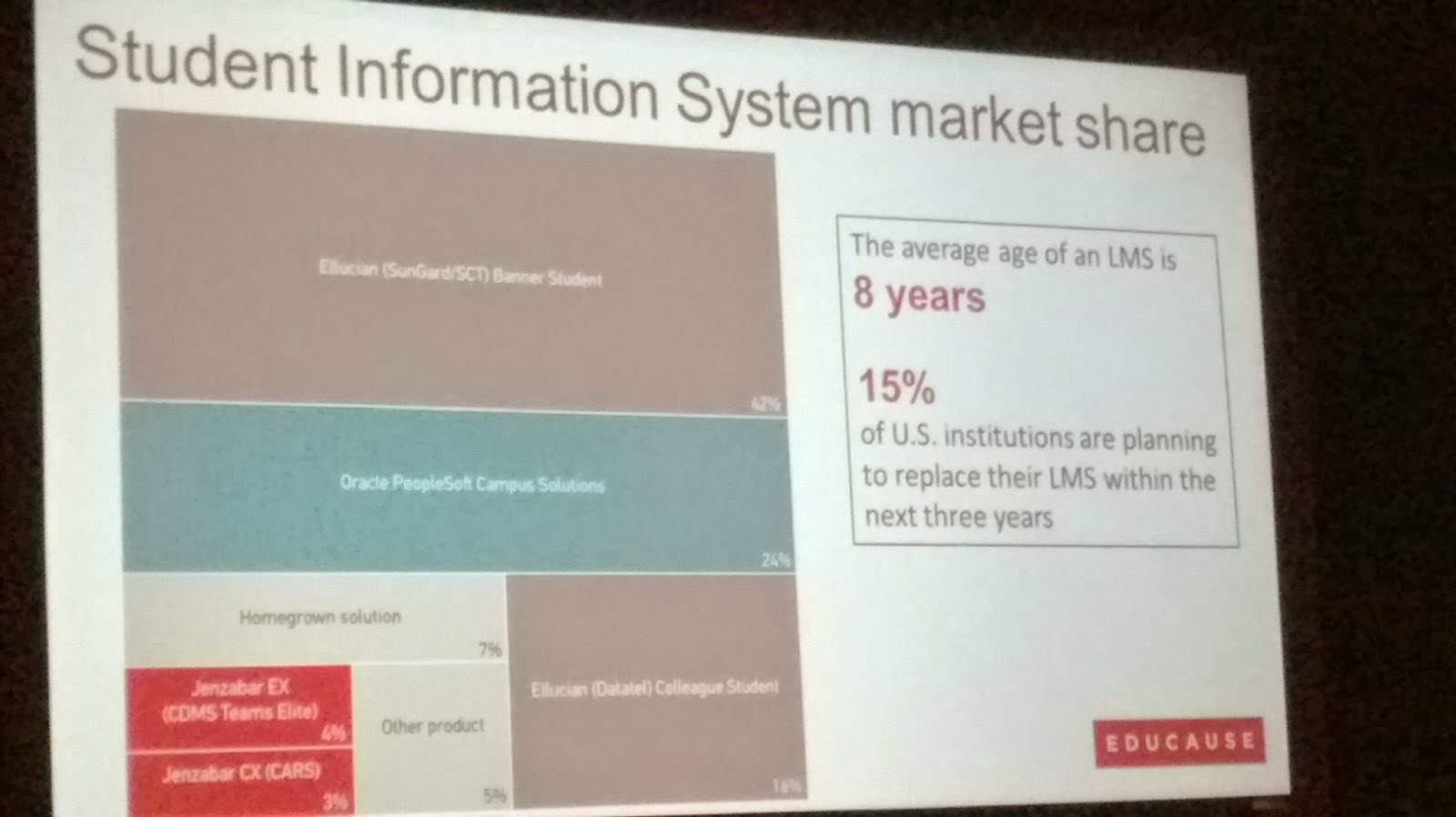
And, US Student Information System market share


Educause 2014: IT Benchmarking and the EduCause Core Data Service


Actually, the title of this presentation is 'Educause 2014: Transform IT with a New Generation of IT Assessment Tools' but the new title is a better decription of what I've actually written below.
So, first up at 8am is a session delivered by an EduCause organisation called Core Data Service.

Presenters include
-          Leah Lang, Manager, Core Data Service, EDUCAUSE
-          Ronald Yanosky, Senior Research Fellow, EDUCAUSE
CDS are about creating tools and benchmarks to evaluate IT value and to publish collected data from the Higher Education sector.  There is a free annual benchmark.  If institutions participate then they gain access to the benchmark data.  This year they expect around 800 institutions will participate.
The benchmark data is pretty helpful and allows comparisons between institutions.  In the UK, many institutions use the Tribal benchmarking service.
I asked the presenters about International participation.  They have about 50 International participants including a few in the UK.  However, Leah did make the obvious point that ‘like institution’ comparison would be difficult.  At the moment the 50 Internationals are lumped into one category ‘which doesn’t make sense to us’.
During the session we’re asked to vote online https://www.polleverywhere.com/leahlang400
Q: Who measures the value of IT?  Out of about 30 respondents – 1 does, 15 sort of, 14 no. 
Benchmark data provided by CDS outlined below.
A fair number of Institutions provide help desk support by Instant Messaging (37%) with less offering by text (8%).  We don't do either at the moment but probably should.
Automatic Lecture capture systems are not popular. Automatic lecture-capture systems (audio only) (0%) .  Automatic lecture-capture systems (audio and video) (1%)
58% of institutions had an increase in funding from FY 2010/11 to FY 2012/13 - median increase was 19%

$925 is the central IT median spent per institutional FTE (students, faculty, and staff)
 

The following benchmark data is available on-line:
Extracts of particular interest below.
SUPPORT SERVICES
15% Support services spending as a percentage of central IT spending
2.2 Central IT support services FTEs per 1,000 institutional FTEs
0.2 Walk-in tickets (annually) per institutional FTE
0.9 Phone tickets (annually) per institutional FTE
0.5 E-mail tickets (annually) per institutional FTE
75% Institutions offering help desk services via web form
-       Offered by us
37% Institutions offering help desk services via instant message
-       Not offered by us
8% Institutions offering help desk services via text message
-       Not offered by us
35% Institutions offering full support for smartphones (any type)
-       Only for staff
44% Institutions offering full support for iPads or other tablets
7% Institutions offering full support for e-book readers
78% Institutions offering assistance with mobile apps for faculty and staff
39% Institutions offering tablet checkout for faculty and staff
70% Institutions offering assistance with mobile apps for students
25% Institutions offering tablet checkout for students
Learning technologies most commonly deployed
• Clickers (90%)
• Document management tools (86%)
• Hybrid courses (85%)
• Blogs (83%)
• Collaboration tools (82%)
Learning technologies most commonly being considered or planned
• Early-alert systems that identify at-risk students (39%)
• Open content (35%)
• Gaming (34%)
• Information literacy requirement (33%)
• E-textbooks (32%)
Least common capabilities in centrally scheduled classrooms:
• Automatic lecture-capture systems (audio only) (0%)
• Automatic lecture-capture systems (audio and video) (1%)
• Two-way video conferencing (2%)
CORE METRICS
$ 902 Total central IT spending per institutional FTE (students, faculty, and staff)
$4,938 Total central IT spending per institutional employee (faculty and staff)
4% Total central IT spending as percentage of institutional expenses
86% Central IT operating spending as a percentage of total central IT spending
12% Central IT capital spending as a percentage of total central IT spending
1% Central IT training spending as a percentage of total central IT spending
2% Central IT outsourcing spending as a percentage of total central IT spending
54% Central IT compensation spending as a percentage of total central IT spending
4% Central IT staff as a percentage of institutional employees (faculty and staff)
18% Student workers as a percentage of total central IT FTE
7.5 Central IT FTEs per 1,000 institutional FTEs
INSTITUTIONAL IT STRATEGY
53% Institutions whose highest-ranking IT officer is on presidential cabinet
54% Institutions with a designated student technology fee
$ 240 Median student technology fee (annualized)
50% Percentage of central IT spending in support of institutional administration
40% Percentage of central IT spending in support of teaching and learning
0% Percentage of central IT spending in support of research
79% Percentage of central IT spending on running the institution
13% Percentage of central IT spending on growing the institution
6% Percentage of central IT spending on transforming the institution


Tuesday, September 30, 2014

EduCause 2014: Introducing Visual Strategic Planning Using Four Higher Education Business-Model Scenarios and Strategic Technology Maps

This session presented by Gartner Vice President and Education specialist Jan-Martin Lowendahl.

Abreviated highlights below.

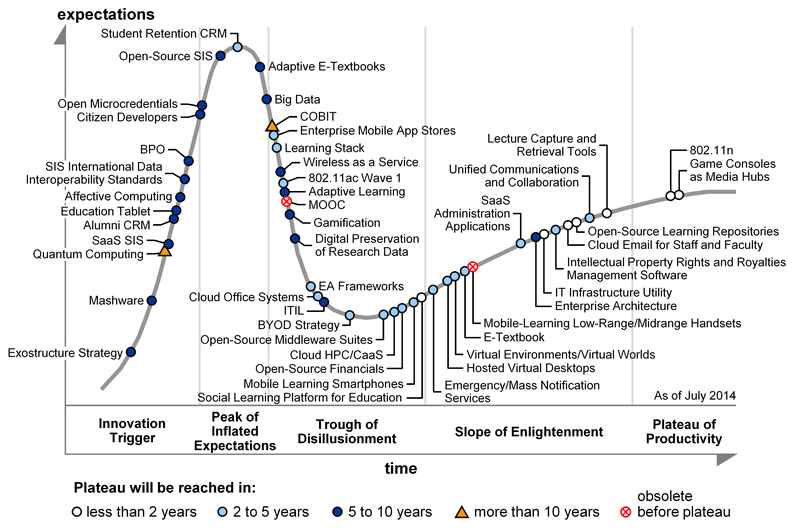
Gartner Education hype cycle - which is pretty helpful and pretty new (July 2014):


Jan-Martin's presentation was delivered via a number of unpublished slides but main points (unsurprisingly) include:
- Increasing momentum in Higher Education to 'buy' rather than 'do it yourself'
- Education technology ecosystem is expanding and options are many
- Technology is pushing Education and Education is pushing technology

Key issue to address:  "What investments in IT will be strategic in positioning the institution for long-term success?"  Jan-Martin emphasises that extra funding for long term success is not optional.  Significant investment will be required.

A context (not in the presentation) explored in An avalanche is coming: Higher education and the revolution ahead , Laurence Summers, Professor and President Emeritus Harvard University, and others argue that the existing HE sector faces an existential threat as a result of rapid technological change and globalisation (Barbe, Donnelly, & Rizvir, 2013). More positively, the paper also suggests that HE is at an opportunity crossroads and a ‘golden age’ over the next 20 years is possible – based on this collision between technology, globalisation and HE.    Laurence's paper is definately worth reading and provides a bit of depth.

Jan-Martin presented a quadrant (of course) of four Higher Education business models comprising 'Only Us Uni, Everybody's Uni, Me not U, All about you'. 


Only Us Unis - e.g. Harvard.  Interestingly, they are planning a MOOC just for alumni.  <1% of institutions.
Me not U - niche University.  10% of institutions.
Everybody's Uni - everything for everyone - driven by volume.  About 80% of institutions.
All about you Uni - Opportunistic, economy of speed, agility, brokerage University (just right, just-in-time, any place education).  About 10% of institutions.

Our University is one of the 80%:


And, 'Everybody's Uni' technology hotspot:


Towards 2050, 'All about you' Unis will grow to 45% - so this is the big growth business model.  The big losing business model will be the 'Everybody's Uni' approach.

Jan-Martin observed that 'no institution is profitably offering MOOCs.  Instead being funded by venture capitalists or by insitutions absorbing the loss'.

So, what are Education focused vs global (i.e. everyone else) priorities according to Gartner?
 

EduCause 2014: The On-Demand Model for HE: Providing Education as a Service across Colleges and Universities

Sponsored by Campus Management, this session concentrated on the idea that "institutions are facing a convergence of forces that, combined with an outdated technology infrastructure, have created the need for a new approach in education technology: the On-Demand Model for Higher Education. Hear from this dynamic panel about rising above technology challenges to empower dynamic models of engagement and delivery and, in turn, positively impact growth, retention, and financial security. "

Perhaps a rather unsatifying session but maybe useful comments about MOOCs (Massive Open Online Courses).

Speakers:
Ann Taylor, Director, John A. Dutton e-Education Institute
Navneet Johal ,Education Technology Analyst, Ovum
Karli Grant, Manager, Product Marketing, Campus Management
Connor Gray, Campus Management

I guess this session might be able to be linked back to Professor Clay Christenson's session on disruptive innovation.  Campus Management are pushing online or 'out of class' learning and technology.   With 'Engagement, Flexibility, Agility' being headline words.  From the presentation, it was not entirely clear what the specifics were on the use of technology to deliver an 'on-demand' model for Education.  It was clear that the presenters thought there are a number of challenges around course or module authoring right through to delivery.  When ought the lectures be delivered?  When should blended face-to-face and on-line learning be provided?

Should Education institutions redefine themselves?  Ann Taylor reckoned "big, small, public, private.  They need to really go back to their mission and make sure they are the right kind of institution.  As long as they stay focused at what they are good at then they will be competitive.  But, remember, the next institution is just a click away".  I guess this last point is pretty true - on-line students don't need to move house to move to another institution.  Just move web sites.

What about MOOCs? Navneet Johal of Ovum thought:"without sounding too skeptical, I can see its value as a marketing and branding approach.  For the most part, the hype is reducing and Institutions do not see MOOCs as a priority.  MOOCs need to be offered for the right reasons.  I can see far less MOOC orientated stuff here at EduCause compared to last year".   

Ann Taylor thought much the same: "coming from an institution that provides MOOCs I completely support that.  They have been a fun way to re-enforce our brand.  For personal enrichment then they are great.  We've seen a 24% increase in demand for our traditional online paid for courses - I think because of the marketing presence MOOCs have given us".

So, the panel didn't think MOOCs were much of a threat to traditional higher educational institutions.

Connor Grey did think that there were big challenges and highlighted that a number of CFOs did not believe the current HE funding model is viable "People feel secure 'until the collapse'".  He suggested that 'Agility' is probably a key capability that institutions need to develop to be competitive.  With the Campus Management technology providing a good foundation.

Educause 2014: Main session #1 Disruptive Innovation and the future of Higher Education


On to the main feature - Disruptive Innovation and the future of Higher Education.
The main keynote speaker is Clay Christenson who was voted the ‘most influential thinker’ by the top 100 CEOs and is a leading Harvard professor.  He’s also a lay preacher.
Clay suggests that disruptive innovation tends to be allied to decentralisation.    Sustained innovation is different (I think he perhaps means that incremental improvement of an existing product = sustained innovation as distinct from disruptive innovation). 

Quote  "Words we didn't use 10 years ago: social media, smartphone, apps, WiFi, Twitter, MOOC, WiKi, 3D printing and wearables"
An example from the 80s is Digital.  They were original innovators with their disruptive – to IBM – MINI computer technology.  But Digital too were overtaken by another ‘decentralised’ disruptive innovation.  This, of course, was the PC and upstart Microsoft.    Initially, Digital didn’t recognise the threat, were dismissive and thought PCs were not really suited to the business environment.  But, decentralised business units started buying PCs and new innovators started making cheap software for these PCs.    Digital tried to combat the PC by initially providing better software on their MINI computers – an approach that Clay describes as ‘incremental innovation’ – i.e. make the same product a bit better.  This, of course, was a doomed strategy with IBM, Intel and Microsoft eventually dominating a brand new huge consumer market and vastly bigger business market.  But, the main point is that there is a central thread of decentralisation running through disruptive innovation.  We can also think about Wang, Data General, Sun, Silicon Graphics and others whose demise followed the same track.
Clay makes the point that ‘modularity’ is also a central component of disruptive innovation and is allied to decentralisation.   If a new product can both take advantage of decentralisation and is also modular then watch out.
Adam Smith’s ‘invisible’ hand of informed capitalism suggested that capital will be spent efficiently without need for much central control.   In the 70s Alfred Chandler wrote the ‘visible’ hand of managerial capitalism.  Chandler’s suggestion is that there needs to be a managed and directed approach to some aspects of capitalism e.g. transport infrastructure needs to be co-ordinated and managed to ensure there is a strategic, long term and sustainable investment approach.  Without this longer term and planned approach much of what we, as a society, need will not be provided efficiently or at all.  Other examples might be power infrastructure and perhaps Education which is the focus of this presentation.
Clay suggests that Higher Education is moving more from ‘visible’ to Adam Smith’s original ‘invisible’ informed capitalism via modularity.  What does this mean?  Higher Education is moving towards providing widely available and online modules.  This could be game changing with ‘customers’ able to take individual accreditations from many institutions and put these together towards a qualification.  This probably isn’t what institutions expect or recognise as a serious challenge but, Clay reckons, a momentum might grow.  New Higher Education providers will offer their own accreditation and build on accredited modules provided by traditional Universities.  This would perhaps lead to major disruption with traditional Universities driven towards more short term decision making driven by economic imperatives – leaning towards Adam Smith’s ‘invisible’ informed hand of capitalism. 
Disruptive innovator, Apple, have created their closed, proprietary and interdependent product architecture.  Obviously, this has been tremendously successful and has catapulted Apple to be the most valuable quoted public company.  Clay suggests there is danger ahead.  He draws parallels with Digital et al in the 80s.  Android, with its modular and decentralised approach, now has 80% Smartphone market share.  Will Apple’s technology fall off a cliff? – driven by Android’s decentralised and modular approach?  Clay's not sure but it would fit the theory.

First part of this session was spent congratulating people serving on Educause committees and awards for contributions over the past year. Fair enough and perhaps quite American. We don’t do this in the UK very well. People seem to be taking the awards quite seriously with some tears being shed. In Europe, we’re probably too cynical and lacking in clear eyed confidence to take this stuff as seriously. I could be wrong.

Wireless

Wireless.  Almost ubiquitous and we expect it to be reliable and speedy wherever we are.  Or at least in main centres and, of course, around our university campuses.  As a provider of a Wireless service I know how much effort and technology goes into getting it right.  And, it's not easy to keep up with demand.  But, this is perhaps where we can trip up.

Gartner, a couple of years ago, predicted that we should be planning for 3-4 devices per person.  I was a bit doubtful.  Would people really wander around with so many IP conected devices? Here at the conference Hilton Orlando hotel there is wireless everywhere.  But, I can only really get on reliably after midnight and before 7:30am.  Other times, well, not so feasible.  Actually, it's much the same at the conference venue - using the standard WIFI.  Pretty unreliable.  The conference staff told me they've been complaining for ages.  EduCause, to their credit, have overlaid another wireless network to augment what's there and their wireless is in excellent shape.

So, what's gone wrong?   Well, I can't obviously be sure but I'd bet it's all about capacity planning.  There is obviously an associated cost but I reckon this is probably less of a factor.  The Hilton probably planned for casual use by a limited number of people with a low number of IP devices.  Gartner's device per person prediction is probably in sight of coming true.  Perhaps with the growth of IP connected fitness / medical devices, watches and our desire to be 'always connected' we'll see even more growth.   We're also now absolutely reliant on wireless in a way that wasn't perhaps true only two or three years ago.

What do we need to do?  It's reminded me that we need to be sure our capacity planning is sensible.  How many devices, per person, per area, per campus?  We did this a couple of years ago but could be refreshed.  So 3 devices per person x 4000? people on campus = 12,000 active IP connections at our Cambridge Campus.  We don't yet have this capability.   Actually, need to stop.  The wireless just gave out.

Wireless data goldmine

That's a pretty good segway into the next presentation by Rens van der Vorst from Fontys University where he is Head of Innovation and Roel Smabers CEO of Parantion Group.   Both from the Netherlands.

The premise is that our wireless data are a potentially goldmine: “Using your wireless data, you will be able to improve life on campus, provide exhilarating services to students and staff, enhance learning, and make life easier and a lot more fun. We used our local big data, and you can do it too!
They extensively used infographics to engage students.  Below is an example showing the ‘garden’ with the number of ‘bees’ representing the number of users online using wireless.  They reckoned showing easy to understand graphics helped students understand why the Wireless gets slow.  This understanding means students are more supportive, they thought.

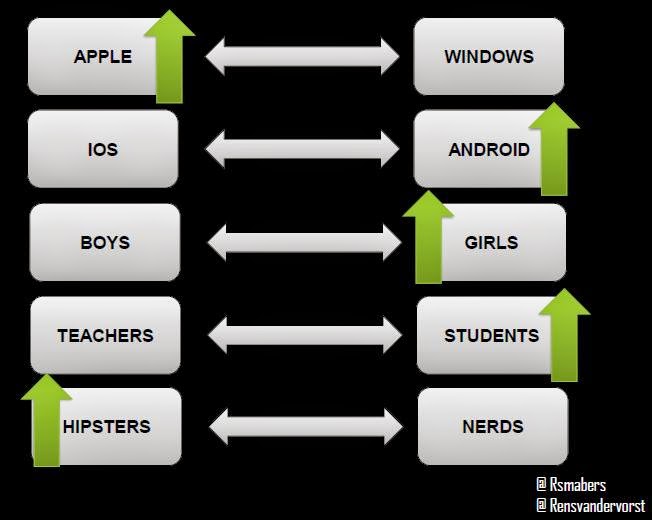
Bit of statistical data below – which is always interesting.
So, this is showing that over a time period (remember, their language not mine – maybe the Dutch to English translation isn’t quite right!):
·         More Apple than Windows used
·         More Smartphone Android than IOS
·         Girls more active than Boys
·         Students more active than teachers
·         Arts students more active than science based students
Interesting use of data and pretty entertaining presentation. 

The use cases can go quite far, of course.    Correlations between wireless use, location, attendance, results and demographic and data might, they suggest, create a great picture of student behaviour and outcomes.  But, maybe the wireless data is one of the weaker correlations we could make?

Monday, September 29, 2014

EduCause 2014: Implementing IT Accessibility on Your Campus: Sharing Strategies That Succeed - first seminar

Right, first pre-conference on the rather dry subject of  'Accessibility'.  Here goes - and  I do appreciate that I've been on the periphery of Acessibility up until now.

Around 15 in seminar.  Almost all are creating or already have an 'accessibility committee' - couple of participants have 'accessibility' in their job title... 

Great set of accessibility guides, documention here:
http://accessibility.ncsu.edu/

There is also a procurement guide which might be helpful for us:

"All information and communication technology purchases must adhere to the Information and Communication Technology (ICT) Accessibility Regulation. Additionally, bidders for purchase orders must provide additional accessibility documentation"

Great but slightly scary templates for vendors to fill in as part of an ITT and procurement process:
http://www.calstate.edu/Accessibility/EIT_Procurement/   A standard US Federal 'VPAT' accessibility set of criteria has been taken up by some forward thinking US Universities. 

10 key facts about English contract law: http://www.seqlegal.com/blog/10-key-facts-about-english-contract-law

All this accessibility stuff might be helpful for our new web site (CMS - SiteCore) and new student management system (SITS Core).

Maybe especially good material here: http://accessibility.oit.ncsu.edu/training/it-accessibility-quick-guide.php

Even more at California State University:
http://www.calstate.edu/accessibility/

A pretty good 'status level' evaluation definition for where you are in the accessibility journey:
https://www.educause.edu/annual-conference/2014/seminar-13p-implementing-it-accessibility-your-campus-sharing-strategies-succeed-separate-registration

Actually, there are pretty well developed templates and guidance for almost everything you might need on the link above.  The presenters from Cal State Uni were keen that their efforts might be of help to others.

Not to be outdone, the UK government provides guidance on how to get to at least AA status

https://www.gov.uk/service-manual/user-centred-design/accessibility

A reminder of the legal position.  The Equality Act 2010 says that "A person ... concerned with the provision of a service to the public or a section of the public (for payment or not) must not discriminate against a person requiring the service by not providing the person with the service."
http://www.seqlegal.com/blog/website-accessibility-and-equality-act-2010

Contributions to the round-table discussions may have been compromised by my accent somewhat.  Presenter suggested a good use of 'Captioning' was for the new Scottish Dr Who but he was looking at me.

Finally, the RNIB has a great page on accessibility:
http://www.rnib.org.uk/about-rnib/web-accessibility-statement

http://www.w3.org/TR/WAI-WEBCONTENT/